05 May, 2026
Dimensional Calibration: Getting the Measurement R



Qatar's telecommunications infrastructure — supporting smart city development, Ooredoo and Vodafone networks, data centres, oil and gas telemetry, and critical government systems — relies on fiber optic cables carrying vast amounts of data at the speed of light. The instruments that test, measure and certify this infrastructure must themselves be accurate. That is where optical and fiber optic calibration comes in.
What Is Optical Calibration?
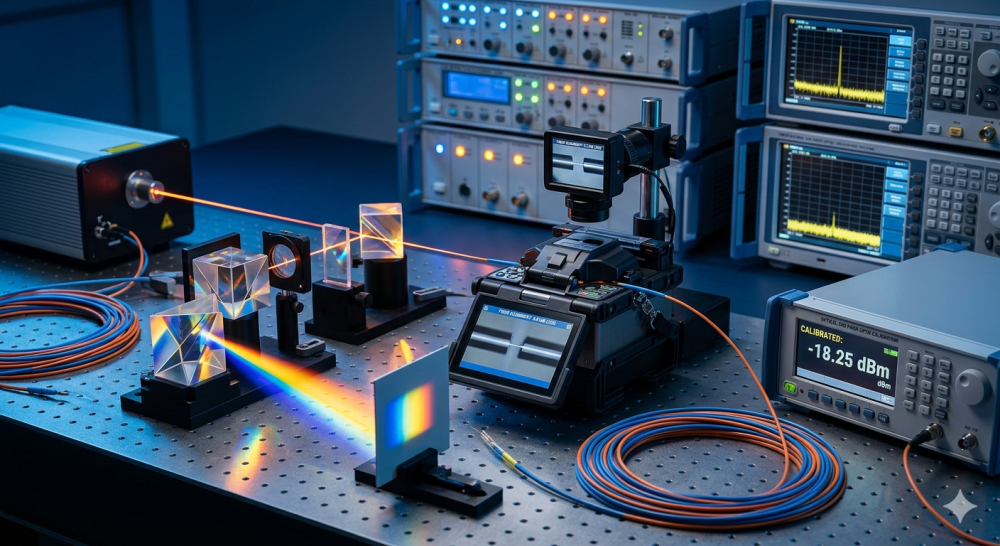
Optical calibration covers the verification and adjustment of instruments used to measure optical power, wavelength, attenuation and the condition of optical fiber networks. It ensures that the test equipment used by fiber optic engineers produces accurate, reliable and repeatable measurements — so that the networks they certify are genuinely fit for purpose.
Why Optical Instruments Need Calibration
Optical instruments are sensitive and precise. Optical power meters can drift with temperature, aging photodetectors and connector wear. OTDR instruments require calibration to ensure their distance and loss measurements are accurate. Laser sources must produce stable, accurate output power at the correct wavelength for loss test sets to give reliable results. Without regular calibration, an engineer may certify a fiber link that has marginal performance — a link that passes today but fails under load, or one that is wrongly failed causing unnecessary rework.
Key Optical Instruments That Require Calibration
Optical calibration covers a comprehensive range of instruments:
OTDRs (Optical Time Domain Reflectometers)
OTDRs are used to locate faults, measure splice and connector losses, and verify the end-to-end integrity of a fiber link. Calibration ensures the distance accuracy, loss measurements and event detection are reliable across both single mode (1310/1550 nm) and multimode (850/1300 nm) wavelengths.
Optical Power Meters
Optical power meters measure the light level in a fiber optic cable, typically in dBm or uW. Calibration ensures that the power readings are accurate — which is essential when verifying that a fiber link meets its loss budget specification.
Laser Sources and Light Sources
Calibration of laser sources verifies their output power and wavelength — the two parameters that determine whether an optical loss test set gives accurate results. At Vertex, we calibrate CW laser sources, tunable laser sources and stabilised sources across the key telecom wavelengths.
Optical Spectrum Analyzers (OSA)
Used in dense wavelength division multiplexing (DWDM) networks and research applications, OSAs require calibration of their wavelength accuracy and power measurement capability to ensure correct channel identification and power monitoring.
Optical Attenuators
Fixed and variable optical attenuators introduce a known, precise loss into a fiber link — used in testing and network management. Calibration verifies the actual attenuation value against the specified value.
Optical Loss Test Sets (OLTS)
OLTS equipment is used by installers to certify fiber links to standards such as TIA-568 and ISO/IEC 11801. Accurate calibration of the source and meter is mandatory for certification results to be valid.
The Cost of Uncalibrated Optical Test Equipment
Uncalibrated optical test equipment leads to two categories of costly mistakes. The first is accepting a failing link — certifying a fiber installation that does not actually meet the loss budget, leading to performance problems after commissioning. The second is rejecting a passing link — spending hours re-splicing and replacing components in a fiber link that was actually within specification, because the power meter or OTDR was reading incorrectly. Both outcomes are expensive, and both are avoidable with a simple calibration.
A2LA Accredited Optical Calibration at Vertex
Vertex Calibration is accredited by A2LA (Certificate No. 7399.01) for optical calibration including OTDR calibration at 1310 and 1550 nm for single mode and 850 and 1300 nm for multimode, optical power meters, laser sources (CW stability: 0.007 dB), optical spectrum analyzers, variable optical attenuators from 0 to -50 dB, and optical loss test sets. We also offer functional testing and verification for fusion splicers, fiber cleavers and visual fault locators.
Conclusion
The reliability of Qatar's fiber optic infrastructure depends on the accuracy of the instruments used to build and certify it. Vertex Calibration provides the A2LA accredited optical calibration services that telecommunications engineers and network owners need to have confidence in their test results — and in the networks they are responsible for.
© Copyright 2026 -Vertex. All Right Reserved
Made with by Weblanza